
This page contains official CONvergence policies on a variety of topics. If you have any questions about anything on this page, please contact CONvergence.
CONvergence Attendee Conduct Policies
CONvergence is dedicated to providing a safe and inviting convention experience for everyone. These policies support the goal of ensuring that the behavior of any individual or group does not harm other attendees or detract from the Core Values of CONvergence.
Attendee conduct policies apply to badged attendees, volunteers, members of the ConCom, Invited Participants, Guests of Honor, dealers, vendors and all other individuals that have gone through official channels in order to participate in convention activities.
CONvergence reserves the right, at its sole discretion, to take such actions as it feels appropriate where any individual or group is found to have breached convention policies or behaved in a manner contrary to the Core Values. Although we consider our attendees to be rational and responsible people, we recognize that issues related to the policies may still arise. We will deal with any issues as promptly, efficiently, and fairly as possible.
CONvergence reserves the right to revoke any pass and to eject anyone at any time from the convention without a refund.
Jump to…
- Vaccination and Mask Recommendations
- City, County, State & Federal Laws
- Prohibited Representation
- Harassment
- Minors
- Animal Policy
- Artificial Intelligence (AI) Art
- CONvergence Badges
- Fraudulent Badge Use
- Financial Transactions
- Props
- Costumes/Clothing
- Alcohol & THC
- Smoking
- Photography Policies
- Planned “Spontaneous” Group Activities
- Tape
- Litter
- Volunteering
- Guests & Invited Participants
- Elevators, Escalators, and Moving from Floor to Floor
- Press Procedures
Vaccination and Mask Recommendations
Recent masking studies show that individual masking choices have a greater impact on personal health than previously thought. Because of this it is highly recommended but not required that all attendees ages 3+ wear masks during the convention.
This is especially important if:
- You had symptoms or a positive test 5-10 days before the convention.
- You were exposed to someone with COVID-19 within the 10 days prior to the convention.
- If you have concerns about COVID-19 and/or the indoor air quality.
In addition, if you are immunocompromised or at increased risk of severe COVID-19 illness, consider asking your health care provider for advice on additional COVID-19 precautions you should take.
We will continue to provide N95/KN95 masks for when attendees find themselves in need of one.
Furthermore, It is strongly recommended that all attendees be fully vaccinated.
- We hope to once again have updated vaccinations available at con on Saturday afternoon for those who have been unable to find them.
It is strongly recommended that attendees have a negative COVID-19 test within 48 hours of the start of CONvergence.
CONvergence reserves the right to update this policy with more stringent guidelines if the Wastewater Virus Data for Minnesota shows surge conditions at the time of the convention.
If you have any questions or comments about COVID-19 policies at CONvergence 2025, please contact the CONvergence board of directors.
City, County, State & Federal Laws
Please remember: whatever applies outside of the convention still applies both inside the hotel and in all convention spaces.
Prohibited Representation
The following is not allowed representation at CONvergence.
Hate Groups
Any representation or iconography of any hate group (included but not limited to: Nazis, the Ku Klux Klan, Westboro Baptist Church or as listed on the Southern Poverty Law Center website as a current or active hate group) is expressly prohibited. Discrimination or prejudiced behavior is not tolerated by CONvergence.
Harassment of any kind will not be tolerated.
Harassment
Discrimination or prejudiced behavior is not tolerated by CONvergence. Harassment of any kind will not be tolerated.
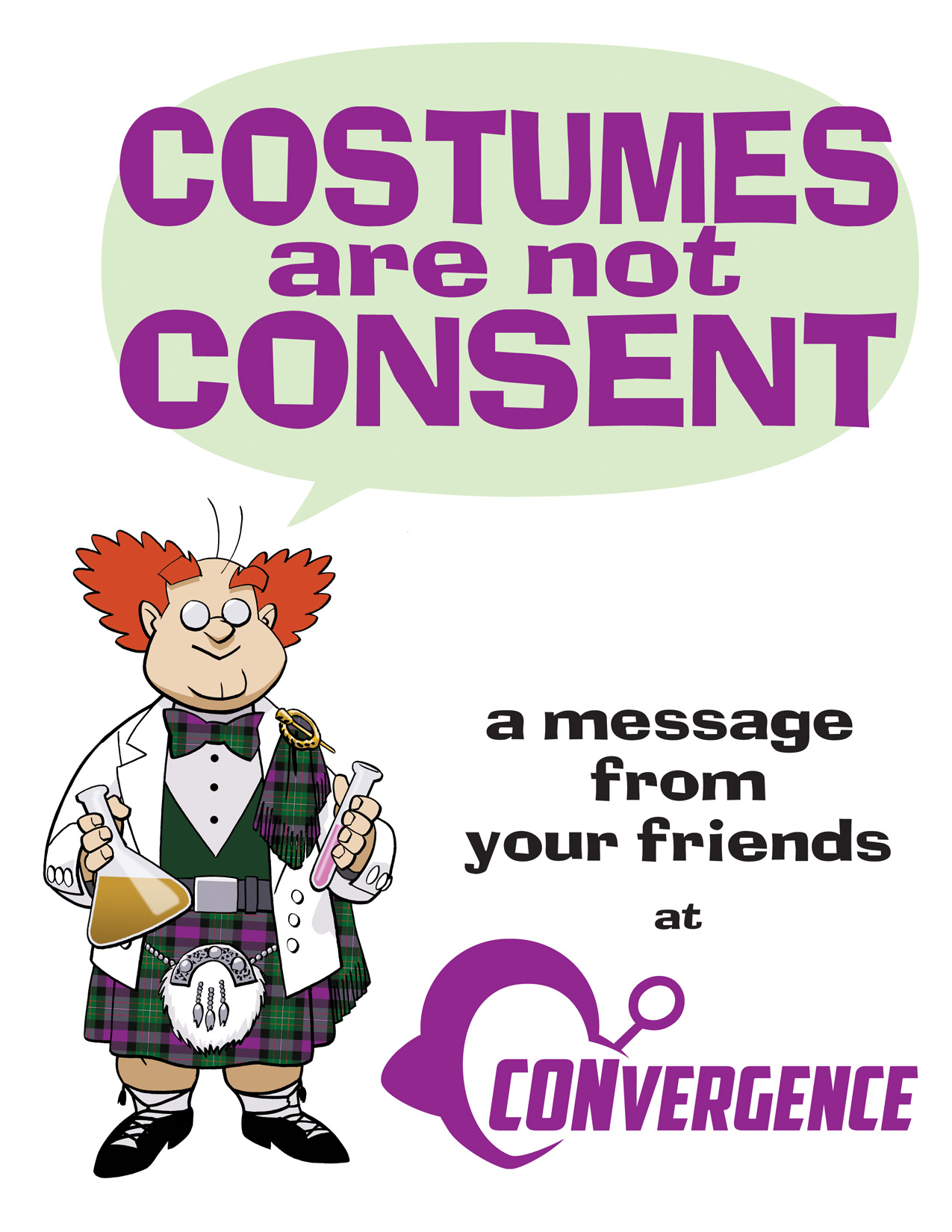
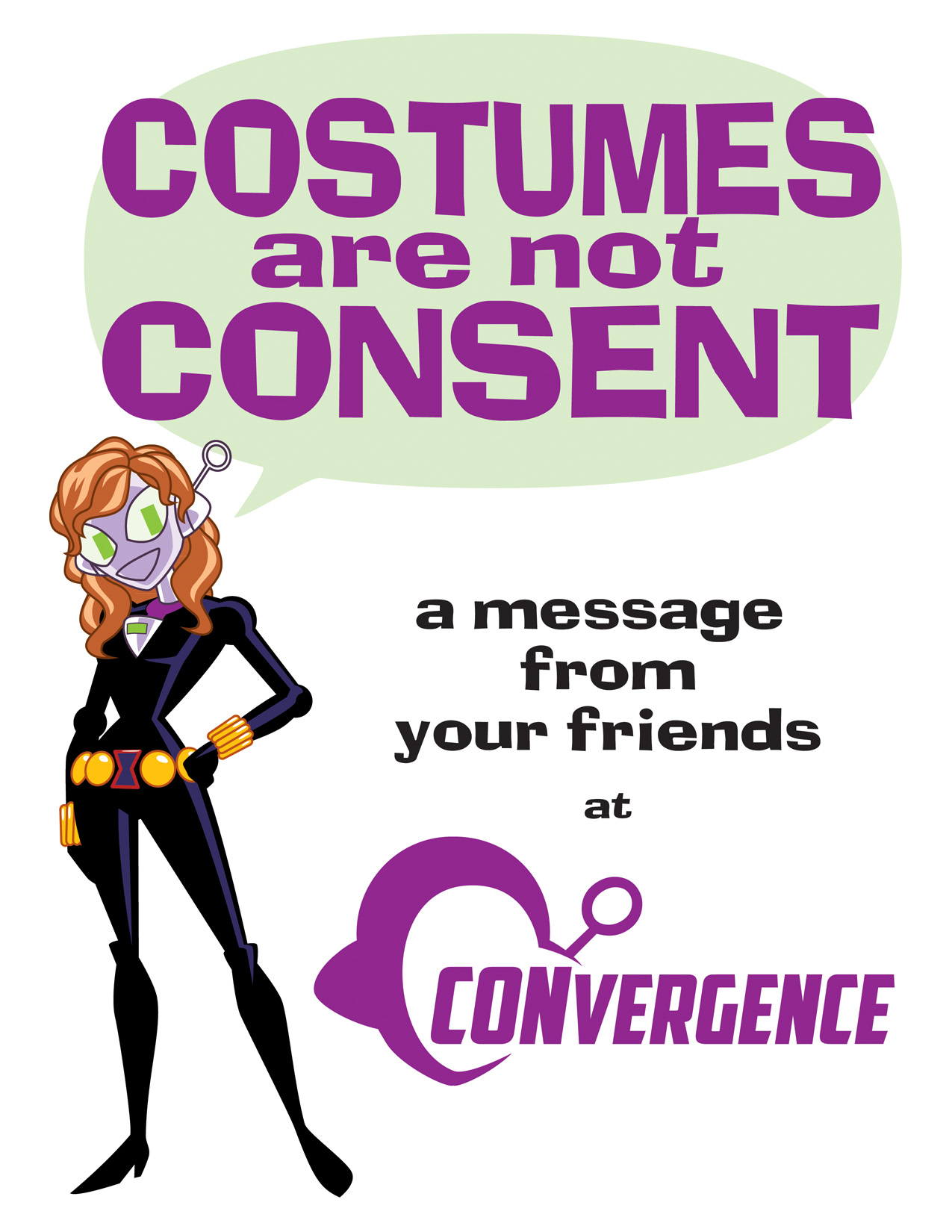
- Physical assault and/or battery
- Offensive verbal comments
- Inappropriate physical contact
- Unwelcome physical attention
- Intimidation
- Stalking
- Display of hateful iconography
- Non-consensual photography or recording (See CONvergence Photography Policy for more
details) - Sustained disruption of panels, signings, or other events
Particularly in relation to identity attributes, including but not limited to:
- Race
- Color
- Culture
- National Origin
- Disability
- Gender
- Gender Identity
- Gender Presentation
- Sexual Orientation
- Religion
- Age
- Body Size
- Appearance
Dealing With Harassment
Anyone can report harassment.
If you feel that you are being harassed or subjected to prejudiced or unwelcome behavior, if you are aware of others being harassed or subjected to prejudiced or unwelcome behavior, or if you notice someone behaving inappropriately (such as violating hotel or convention policies), we respectfully suggest the following:
- If you feel comfortable doing so, point out the inappropriate behavior to the person(s) involved. Often this will solve the problem immediately.
- If you do not feel comfortable talking with the person(s) involved or if talking to them does not resolve the issue, please report the situation immediately to CONvergence Operations. If possible, we ask that you try to provide a name, badge name, badge number and/or physical description of the person(s) involved to assist with subsequent investigation and follow up.
- Do not feel that it is necessary to craft a complete narrative in order to be heard. It is understood that details of stressful situations can become murky and our procedures take this into account. Report situations to the best of your ability and feel free to provide supplemental reports if needed.
- If you are in a situation that makes you feel unsafe, please seek assistance from CONvergence staff immediately. Find a Wandering Host, leave the situation and come to a Safe Space or The Bridge, find anyone on a radio, or text Operations at 651.800.1677 (651 800 1 OPS) and we will come to you.
If someone tells you “no” or asks to be left alone, your interaction with them is over. Do not follow or attempt to disrupt their convention experience in any way. If you continue, against their wishes, to attempt to have contact with people who have said no or have asked that you leave them alone, you may be removed from the premises. If you wish to offer an apology to someone who asked that you not interact with them, please come to The Bridge and CONvergence Operations can assist in relaying your message.
Community Safety
CONvergence is not responsible for solving disagreements and interpersonal problems that may arise between individual pass holders outside of the convention. However, CONvergence reserves the right to revoke any pass and to deny future attendance to individuals found to have behaved in a manner contrary to the Core Values of CONvergence at any event within or adjacent to the local community, or who are otherwise deemed to pose a legitimate threat to the safety, inclusivity, and overall health of CONvergence, its attendees, its parent organization, or event venues. We encourage you to contact CONvergence Operations or the members of the Board of Directors of Convergence Events, Inc. if you have concerns about an individual and their presence at the convention.
Minors
Fans of all ages are welcome at CONvergence. However, CONvergence does not provide childcare, and not all events at CONvergence are appropriate for all audiences.
Attendees under the age of 13 should be supervised in a manner appropriate to their age and ability by an actively responsible parent, guardian, or designated adult while in convention spaces.
A designated adult is defined as someone that is not the legal guardian or parent of a minor, but is over the age of eighteen, a registered convention attendee and identified in the minor’s registration record as an adult responsible for them at the convention. The designated adult must be a registered attendee on each date the minor is also attending.
Registration
Attendees who will be under the age of 16 on the Thursday of the convention are required to provide contact information for a designated adult when registering and must have a parent, legal guardian or designated guardian with a valid weekend or day pass provide legal identification at the time the minor picks up their membership badge. Attendees who will be age 16-17 on the Thursday of the convention must provide contact information for a designated adult when registering. Attendees 16-17 years of age may collect their membership badges using their own form of authorized identification.
Curfew
Hennepin County curfew does not apply within convention spaces. It does, however, apply outside the hotel. The juvenile curfew in the city of Minneapolis is:
- Under Age 12: 9:00pm – 5:00am Sunday – Thursday; 10:00pm – 5:00am Friday & Saturday
- Age 12-14: 10:00pm – 5:00am Sunday – Thursday, 11:00pm – 5:00am Friday & Saturday
- Age 15-17: 11:00pm – 5:00am Sunday – Thursday; Midnight – 5:00am Friday & Saturday
Recommendations
In order that young fans and their parents, guardians, or designated adults may have the best experience, CONvergence recommends that:
- Attendees under the age of 18 should have an Emergency Contact sticker (available in Registration) completed and affixed to the reverse of their badge for the purpose of identifying their parent, guardian, or designated adult in case of emergency. Please ensure that any voice or text number listed on this sticker will be answered regardless of hour or caller.
- Attendees under the age of 18 should be aware of convention support structures, such as Safe Spaces, Wandering Hosts, The Bridge, and the Operations text number (651-800-1677).
- There should be an active means of communication between a parent, guardian, or designated adult and their associated minor(s).
- Parents, guardians, or designated adults should be in areas to which their associated minors have access. E.g. not in a full panel or show, 18+ panel, 21+ party room, etc.
- Time of day should be taken into consideration when assessing age and ability. Areas and events that may be appropriate for young attendees in the afternoon may not be in the evening. Attendees under the age of 18 should avoid convention spaces after 1:00am. Attendees under the age of 13 should avoid convention spaces after 11:00pm.
Animal Policy

Pets are not permitted in convention space. Service Animals, as defined under the ADA, are welcome in all areas of CONvergence.
Distracting a service animal without its owner’s permission is a safety hazard and denies another attendee the benefit of their accessibility aid. Petting, touching, or intentionally distracting a service animal without its owner’s permission is not allowed under any circumstances.
Artificial Intelligence (AI) Art Policy
This policy aims to prevent the sale and/or promotion of any goods or services that profit off of the theft of another artist’s work, while also allowing attendees to submit art generated by AI programs they themselves have created and trained on original art with permission.
This policy applies to all art submissions to the convention, including but not limited to any competitive and/or monetized art submitted to CONvergence. This includes Art Show, Dealers Room, Artists Alley, and any other compensated or competitive venue that may arise.
- The AI program must be an original creation of the Artist or Group of Artists displaying, selling, or entering the work in a competition at CONvergence
- The Artist or Group can collaborate with a programmer or program the AI themselves
- Any programmer must be a named collaborator on all display signage
- The Artist or Group cannot use publicly or commercially available AI programs, including but not limited to: ChatGPT, Midjourney, Craiyon, Fotor, Starryai, Deep Dream, Stable Diffusion, Grok, Google Bard, Claude, etc.
- The Artist or Group can collaborate with a programmer or program the AI themselves
- The data set on which the AI was trained must be 100% original art belonging to the Artist/Group of Artists or used with documented permission
- Public domain art is prohibited from inclusion in the data set
- Data sets must be viewable upon request by convention staff
- Original art used for the data set that is not created by the Artist or Group requires written release from its creator(s)
- Releases needed for:
- Subjects of photographs and videos
- Originating artists who are part of a Group seeking to sell or display but not physically present
- Releases needed for:
- Artist Collective must disclose that their art is AI-generated, whether in full or in part, when submitting their work to CONvergence
- Artist Collective should disclose that their art is AI-generated, whether in full or in part, on any item tags or display signs
CONvergencce Badges
Your convention badge is necessary for participation in the convention. It allows you access to the convention and indicates you are an attendee in good standing. However, CONvergence reserves the right to revoke the badge and the pass it represents and hold the badge of any attendee for any reason, including but not limited to violating the CONvergence Attendee Conduct Policies or behaving in such a manner as is deemed unsafe or unacceptable.
Attempts to enter badged convention space while failing to purchase and display a valid day or weekend pass badge will result in being escorted off site.
Fraudulent Badge Use
The use of ANY CONvergence Badge not issued to you, or the possession with the intent to use of a CONvergence Badge not issued to you, is prohibited and will result in your day or weekend pass being revoked.
Financial Transactions
Anyone who owes an outstanding balance to CONvergence (outstanding balance on pass payment, Art Show purchase, or Dealer’s Room table rental, for example), must settle that balance before being permitted to acquire their membership badge.
Props
We at CONvergence believe that the convention as a whole benefits from the amazing costumes and props brought, worn, and displayed by our attendees. In order for CONvergence to remain an enjoyable experience, everyone must agree to a social contract. This contract is simple: If an attendee agrees to be safe and considerate with their props, CONvergence agrees to let that attendee carry their props in convention spaces. To ensure that prop-carrying attendee abide by our social contract, CONvergence Operations provides The Talk and Peace Bonds props.
The Talk
If you have a prop that meets any of the following criteria, you must come to the bridge to receive The Talk and have your prop peace bonded before carrying it in convention spaces:
- Large or unwieldy
- Is capable of emitting a laser beam or any sort of projectile
- Resembles a weapon from any universe
- Uses wheels for other than accessibility purposes
Peace bonding may also be required in other circumstances, at the discretion of CONvergence Operations. When CONvergence Operations gives The Talk, they outline what is expected of you and your specific props, and provide an opportunity to ask any questions you may have. You will receive a badge ribbon reading “I’ve Had The Talk.” This ribbon must be worn visibly when carrying your props to indicate that you agree to our social contract.
Peace Bonding
Peace bonding is the process of marking a prop so that it may be known to one and all that you agree to be responsible with it. At CONvergence, peace bonding is more about marking that a prop has been inspected and found to be in compliance with CONvergence Operations’ safety procedures than an attempt to render the prop inert. Props must be peace bonded on The Bridge with materials provided by CONvergence Operations. Peace bonding does not carry over from year to year.
In some cases, special care must be taken when a prop is peace bonded:
- Metal bladed or pointed weapons must be secured into a sheath.
- Props normally capable of emitting projectiles or laser beams must be rendered unable to do so.
- Other instances, as determined by CONvergence Operations.
Prohibited Items
The following are not permitted in convention spaces:
- Firearms, disabled or otherwise.
A MN Permit to Carry is not an exception - Explosives/ Pyrotechnics
- Tasers/ Stun Guns
- Pepper Spray/ Chemical Irritants
- Any item deemed unsafe by CONvergence Operations.
We allow the following types of props:
- Knives/ Swords/ Daggers
- Bows
- Bats/ Clubs/ Mallets/ Lightsabers
- Toy / Replica/ Model Firearms
- Many other nifty props! This list is not comprehensive.
Mobility Aids
CONvergence’s props policy generally does not apply to mobility aids used for accessibility such as canes, crutches, walkers, and wheelchairs. Unless on the prohibited items list, such devices are explicitly allowed throughout convention spaces and require neither peace bonding nor The Talk. Attendees are welcome to bring their mobility aids to The Bridge to be inspected and receive The Talk and its associated badge ribbon if they would like to do so.
Exception: Sword Canes must be peace bonded as if they were props.
Tools
This policy is not intended to cover tools such as pocket knives, multi-tools, glue guns, nail clippers, etc. Unless on the prohibited items list, such items are allowed, provided they are being used as tools. If such items are being carried as props, they fall under the props policy, and must be peace bonded accordingly.
Wheels
It is not permitted to ride any manner of wheeled recreational transport device such as a bicycle, unicycle, roller skates or blades, skateboard, hoverboard, or motorized mini-vehicle in convention spaces. Strollers and wheeled mobility devices providing accessibility are permitted.
Flying Things
Deployment of any flying object, be it tethered or free flying, powered or unpowered, is not permitted in convention spaces unless advanced authorization is obtained from CONvergence Operations.
Programming Exceptions to Props Policies
Peace bonding may be removed, and props drawn, wielded, or brandished when an attendee is participating in a CONvergence scheduled event at the discretion of the event organizer (e.g. Masquerade, a stage combat demonstration, etc.). Props used in such a manner must be taken to The Bridge to be Re-Peace Bound before being again permitted in convention spaces. Programming is never an exception to the Prohibited Items list.
Costumes/Clothing
All costumes must conform to the CONvergence Harassment Policy and Prohibited Representation Policy.
Any costume that gives the appearance of being a member of present-day United States military or law enforcement will not be permitted. Exception: Current or former US military personnel may wear their uniforms in a manner consistent with military regulations governing off-duty dress.
The following areas must be completely covered by opaque material:
- Genitals and pubic area
- Cleft of the buttocks
- Nipples and areolas of all attendees, regardless of gender presentation
- Exception: Breastfeeding is never a violation of this policy
Alcohol & THC
- The legal drinking age in the state of Minnesota is 21. No one under the legal drinking age should be offered or provided with alcohol or THC. IDs should be verified before anything is shared.
- Tampering with food or drinks consumed by others will not be tolerated. Anyone found to have tampered with items consumed by others will be expelled from the convention and may face criminal charges.
- Intoxication, to the point of interfering with other attendees or becoming a hazard to yourself, will provoke responses from First Advisors and CONvergence Operations and may result in any of the sanctions discussed above.
- If you feel unsafe, regardless of your level of alcohol or THC consumption, please seek assistance. The safety of attendees is a primary concern of CONvergence. This applies even if you are not of legal age of consumption of alcohol or THC.
Smoking (Nicotine)
The Hyatt Regency Minneapolis is a non-smoking establishment, per state law.
Smokers are encouraged to take advantage of The Grove. The Grove provides easy access to seating, tables, ashtrays, and fellow fans.
Smoking is discouraged in other outdoor locations, as it may interfere with people uninvolved with CONvergence.
Smoking is prohibited:
- Inside the Hyatt
- Inside the skyway
Use of e-cigarettes and other vaping devices is restricted in the same manner as traditional cigarettes.
Planned “Spontaneous” Group Activities (Flash Mobs, Performance Art etc.)
Parades, moving performances, LARP-style games, and other mobile events are welcome at CONvergence. For the maximum enjoyment of all attendees, organizers and participants should consider the following:
Please avoid the following areas:
- Programming spaces (e.g. panel rooms or Mainstage)
- High traffic areas (e.g. ConSuite or The Bridge)
- Room Parties, unless given permission by party hosts.
Please provide advance notice of your event to Operations and Programming. If running an event on the 6th floor (the Holodeck), please also contact Exhibits and Special Events. Events run without prior notification to Operations and Programming may be shut down without warning/
Photography & Audio/Video Recording Policies
There is a lot to see at CONvergence and we know you’ll want to snap pictures or shoot videos of the awesome cosplays and goings on around you. To ensure that all attendees have a good time, we’ve laid out some of the rules and guidelines to keep our event safe and fun.
Photography & Recording by CONvergence Volunteers
By registering for CONvergence, you give your consent to be photographed and/or recorded by convention volunteers acting in their official capacity. This consent may be suspended at any time on a case by case basis, even retroactively. If an attendee wishes to revoke consent for a particular photograph or recording, they must contact directors@convergenceevents.org to address the situation.
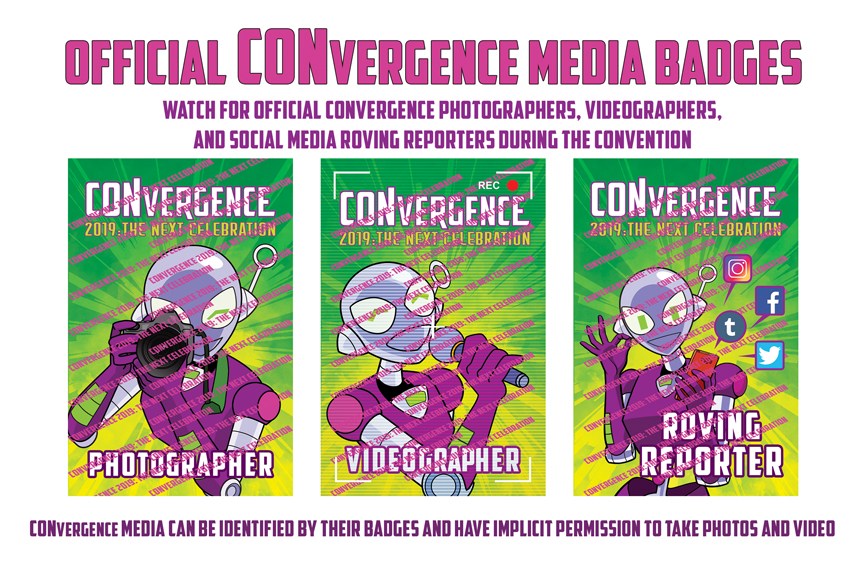
Official CONvergence media volunteers (Photographers, Videographers, and Roving Reporters) can be easily identified by their official badges, listing the current convention year.
 Photography & Recording by Attendees
Attendees must ask permission before photographing or recording specific individuals. Consent may be revoked retroactively. If a subject wishes for a photograph or recording in which they appear to be deleted, they may ask the photographer/recorder to do so, and the photographer/recorder must comply.
All pictures, audio, and/or video captured at CONvergence events must be for non-commercial use, such as social media, with the exception of private photoshoots as outlined below, special commercial exceptions made by the Board of Directors, and approved members of the press.
Crowd Photography & Recording
Prior consent is not required when taking photographs of large crowds (e.g. overlooking the Lobby). Nor is prior consent required from people who appear incidentally in the background of an image or recording, but who are not the primary subject.
Panel/Event Photography & Recording
Panels and Events fall into one or more of the following categories:
- Photography or recording by attendees is allowed
- Recording is taking place by the convention
- Recording is taking place by the participants (e.g. panelists or performers)
- Photography or recording are prohibited.
An announcement will be made at the start of the panel or event which rules are in effect for that event.
Recordings by CONvergence Volunteers
CONvergence records a number of panels and performances for use on our social media channels, including YouTube. By volunteering to speak as part of a scheduled event, participants consent to recordings made by CONvergence volunteers for use by the convention. Any participant may request their event not be published by contacting directors@convergence-con.org, either before or after the event.
Recordings by Panel/Event Participants
CONvergence Photographers and Videographers have priority over areas of event spaces marked off for cameras and recording equipment.
Do not take photographs or make recordings at panels or events at which such activity is announced as prohibited.
Equipment Use
Use of personal recording equipment at panels or events requires that certain considerations be taken into account:
- If you wish for personal equipment to be connected into a CONvergence provided audio system, please contact programming@convergence-con.org no later than June 1 to make arrangements for your equipment to be connected by a designated technician. Connecting equipment on your own is not permitted.
- Placing recording equipment on panel tables is permitted only with permission from all panelists.
Prohibited Photography & Recording
- Flash Photography
Flash photography is not permitted during panels, programming, and mainstage events. For Masquerade-related inquiries, please check with Masquerade personnel for scheduled pre-or post-Masquerade photo sessions.
- Commercial Use
The use of photos, videos, or audio and/or video recordings made at CONvergence for commercial use or for the solicitation of funds for any commercial or other purpose without the express written permission of the Convergence Events, Inc. Board of Directors is strictly prohibited except for approved members of the press.
- Prohibited Locations
Attendees who are not official CONvergence photographers or videographers may not take photographs nor record audio or video in spaces restricted to convention volunteers, such as secured, operational, or confidential locations; and the following: Art Show, Art Auction, Bathrooms, First Advisors, Green Room, Print Shop, any department’s back room, or back of house areas of the hotel.
- Emergency Situations
Please do not interfere with Operations, First Advisors, Emergency Medical Services, or other official personnel that are when responding to an emergency situation. CONvergence reserves the right to ask attendees to delete any photographs or video of any such events if they would compromise personal health information of those involved. Recording law enforcement is allowed under this policy.
Private Photoshoots
Many people are interested in doing professional private photoshoots at CONvergence. We welcome you to do so under the following provisions:
Pictures taken at CONvergence for professional use are prohibited unless a contract and release is received by the photographer from any and all subjects.
- Contracts and transactions must be negotiated and take place outside of CONvergence.
- You may not block off, bar, or otherwise impede any use of the hotel by other patrons or hotel staff. For example, you may not set up a mermaid photoshoot and then prohibit other people from entering the pool during your photoshoot.
- You may not use the CONvergence Photo Studio for private photoshoots.
- Photographers and subjects are all subject to the CONvergence Badge Policy.
Tape
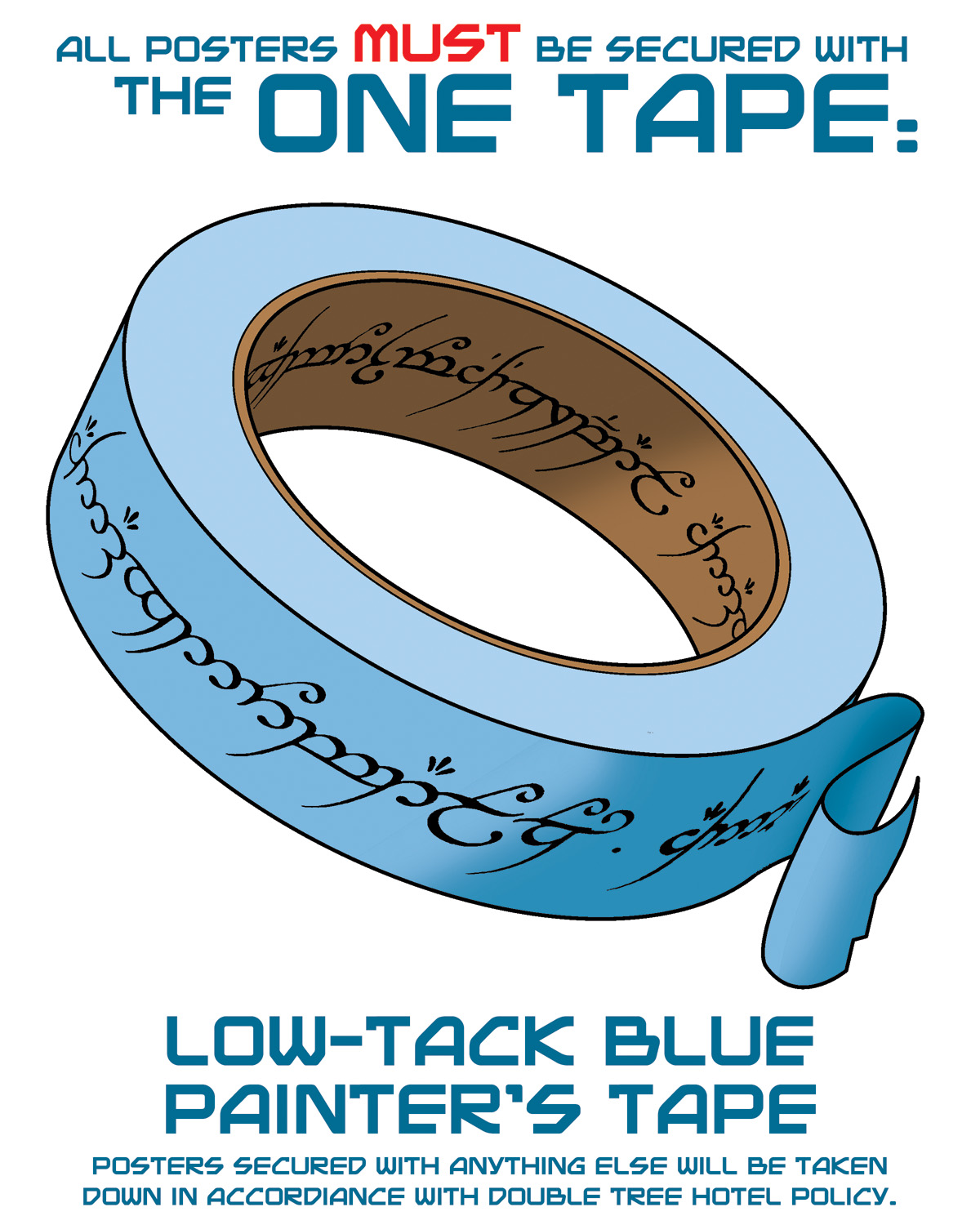
You may post non-adhesive signs with low-tack tape. The Hyatt Regency specifies and requires use of Low-Tack Blue Painter’s Tape so that surfaces that will not be damaged by tape removal. There are no specific brand or model requirements. Any low tack blue tape is allowable. If you do not have acceptable blue tape, come to The Bridge. We have plenty and are happy to share. Neither the convention hotel nor CONvergence will tolerate the application of stickers or high-tack tape to hotel surfaces. Removal of these adhesive substances is damaging to the hotel, and is therefore considered to be unacceptable. Incidents of this kind will be treated as vandalism. Don’t break the Hotel.
Poster Hanging Guidelines
Posters, signage, and flyers may be hung in CONvergence event spaces on floors 1, 2, 3, 4, 5, and 6, in party hallways on floors 3, 4, and 5, and the elevator waiting areas for guest room elevators on floors 2 through 24.
Posters, signage, and flyers may not be hung in the following areas:
- The Hyatt front desk, Hyatt Marketplace, Fireside Lounge, the Prairie Kitchen & Bar, or from railings overlooking any of the above.
- In stairwells, escalators, elevators, or elevator doors.
- In the skyway bridge connecting the Hyatt with the Millenium, on storefronts or in businesses co-located with the Hyatt, including the Fedex, Vitali’s Cafe, and Salon Blu.
- On glass surfaces, or anywhere outdoors, The Grove, the Loring Greenway, or any parking ramp.
Methods:
Blue painters tape is the only allowed adhesive. Painters tape may not be attached to doors or door frames. Magnets are also a permitted method of attaching posters to any otherwise permitted surface.
Times:
- Official CONvergence departments may not hang flyers, signage, or posters in or near CONvergence’s contracted event space for common areas on floors 1, 2, 4, 5, and 6 prior to 12:00 noon on the Wednesday of the convention.
- Attendees may not hanging flyers, signage, or posters in CONvergence event spaces on floors 1, 2, 3, 4, 5, and 6 prior to 6:00 pm on the Wednesday before the convention.
- No posters or flyers of any kind may be posted in party hallways on 3, 4, and 5, or the elevator waiting areas for the Guest Room Elevators on floors 2 through 24, until 12:00 noon on Thursday of the convention.
Posters in party room hallways must be removed by 12:00 noon on Sunday. Posters in other areas must be removed no later than 10:00 pm Sunday. Members who hang posters are expected to also remove them. If the hotel needs to remove posters, charges may apply.
Questions:
If you have questions, please contact Hotel Relations. They may be found on The Bridge during the convention (Mirage Room on the Second Floor of the Hyatt Regency), or may be contacted by e-mail at hotel@convergence-con.org
Litter
Please pick up after yourself. There are trash containers around the hotel. It makes a big difference if we try to keep things clean. Professor Max has not yet provided us with a trash gathering robot!
Volunteering
Volunteering for Convergence Events can be a lot of fun and we value each and every one of our volunteers. But, as with everything else, there is always the administrivia that needs to be documented. To that end, please understand that your volunteering for Convergence Events is at-will and no one has the right to force or guilt you into it. We do sincerely encourage you to, and hope that you will, be proud of the time and effort you put in on behalf of Convergence Events as it is an extremely valuable and highly appreciated gift you provide to our community.
By that same token, when volunteering for Convergence Events, you are agreeing to release and hold harmless Convergence Events from any and all liability, claims, demands, injuries, illness, death, or property damage resulting from your volunteering activities. Convergence Events does not maintain health, medical, or disability insurance coverage for any volunteer or contractor and each volunteer and contractor is expected and encouraged to obtain their own medical and/or health insurance coverage.
Guests & Invited Participants
While CONvergence financially and logistically supports Guests of Honor coming to our convention, CONvergence does not pay appearance fees for Guests of Honor or Invited Participants. The reasons for this are:
- As a nonprofit, we focus on using our funds to support our infrastructure and community.
- Our goal is to invite participants and guests who are excited to engage the convention community and spend time with our attendees, rather than only showing up for their scheduled events.
Guests of Honor
Guests of Honor are professionals and qualified experts in many different fields who are invited as the convention’s honored guests in a given year. Guests of Honor will be asked to participate in a minimum of six panels during the course of the convention. Guests of Honor are welcome and encouraged to participate in more than six panels should they wish to. Guests of Honor are also welcome and encouraged to participate in other events, such as attending any of our Mainstage shows, enjoying our evening Parties, and spending time with our attendees in a more relaxed setting.
CONvergence will cover the following expenses for each Guest of Honor and that person’s optional personal guest:
- Convention weekend pass for that year and all subsequent years
- All travel expenses to and from the convention
- Their entire hotel stay
- All dining (minus alcohol)
A convention staff member will be assigned for each Guest of Honor to act as a personal assistant, help navigate them through our process, and provide support during the convention itself. Guests of Honor are welcome to schedule signing times during the convention to sell merchandise and/or autographs. They may also offer items for sale at the convention’s merchandise booth, and artist Guests of Honor will be guaranteed space to display and sell art in the CONvergence Art Show.
Guests of Honor will receive a personalized bio page on the CONvergence website and a feature in the CONvergence programming guide for the year of their CONvergence appearance. Guests of Honor are also welcome to publish press releases regarding their current work and their CONvergence appearance on CONvergence’s website.
Elevators, Escalators, and Moving from Floor to Floor
We depend on elevators and escalators throughout the convention, and it is in our best interest to keep them from breaking. Because of this, we have instituted the policies and procedures outlined below.
Informational
There are two banks of elevators and one set of escalators. There will also be one set of stairs open to floors with convention spaces.
- The Conference Elevators (two elevators near the escalators) serve convention spaces on floors 1–6.
- The Guest Elevators (five elevators near the front desk, and in various locations on upper floors) serve guest rooms on all floors, with indirect access to convention spaces on floors 1–5.
- The Escalators (centrally located) serve convention spaces on floors 1-5.
- The open Stairwell (near the escalators and conference elevators) provides access to all floors. Note that other stairwells will provide egress to the ground floor but will not allow access to intermediary floors.
Accessibility
Anyone with limited mobility who needs reliable access to elevators may visit the the Accessibility Table to make arrangements.
Escalators and Stairs
Please use either escalators or stairs to access levels 1–5.
Procedure: When boarding the escalators, please leave a gap of 1-2 steps between riders. Cosplayers or attendees with long articles of clothing should take care to avoid becoming entangled in the equipment. When exiting escalators, step off promptly, and immediately move clear of the escalator exit area. Do not stop to talk or look around. Other passengers may be behind you.
Elevators
When using elevators, please follow the instructions of the elevator operator.
Procedure: If the wait time for an elevator exceeds 15 minutes, please text CONvergence Operations at 651-800-1677 and indicate your floor and elevator bank. An elevator operator will be contacted to get an elevator to you as soon as possible.
The 6th Floor
The 6th floor can only be reached via the Conference Elevators.
Procedure: To reach the 6th floor, please use escalators, stairs, or Guest Elevators to get to the 5th floor (or as high as able), and transfer to the Conference Elevators there.
When departing the 6th floor, please transfer from the Conference Elevators at the 5th floor (or as high as able). Use escalators, stairs, or hotel tower elevators to complete your journey.
Press Procedures
 Please email ERAC@convergenceevents.org for press inquiries and interview requests at any time of the year.
Press Tours and Interviews
CONvergence welcomes press and media organizations to visit our event and share the CONvergence story with their audiences. We would be happy to schedule time for you to interview a CONvergence Events, Inc. Director and/or provide you with a full, customized press tour of everything CONvergence has to offer!
- You or your organization must submit a request for a press tour by the Monday before the convention which includes your name, your media organization, the purpose of your visit, and requested duration.
- You will be escorted by a CONvergence Events, Inc. Director throughout your visit to the convention. Most press tours are 1 hour.
- You must agree and abide by the CONvergence Photography Policies.
- We would greatly appreciate you sharing a link to your story, album, or video with us upon publication!
Press Passes
Press passes for CONvergence are available in limited quantities to approved media outlets and personalities.
- You or your organization must request for a press pass by the Monday before the convention. Your request should include:
- Your name
- Links to your media organization or website and social media
- The size of your audience (e.g. average website visitors; subscribers; social media followers; broadcast area)
- The purpose of your visit
- Your requested duration
- Any other information you think we should know
- You must have your request approved before you will be issued a press pass.
- You must present your credentials, a copy of which will be kept on record, upon picking up your press pass.
- You must attend a press tour on the day that you pick up your press pass.
- You must agree and abide by the CONvergence Photography Policies.
- We would greatly appreciate you sharing a link to your story, album, or video with us upon publication!

 © 2026